A finished tower does not reveal whether a robot grasped the blocks, supported the structure during release, or left it standing after retreat. Datumwell Foam Tower retains that sequence: approach, close, lift, carry, support, open and move away.
The collection is inspired by the public AA-Robotics instruction “Make the tallest tower out of the foam blocks.” We use the visible task cues as a reference and record the missing physical quantities as explicit simulation assumptions.
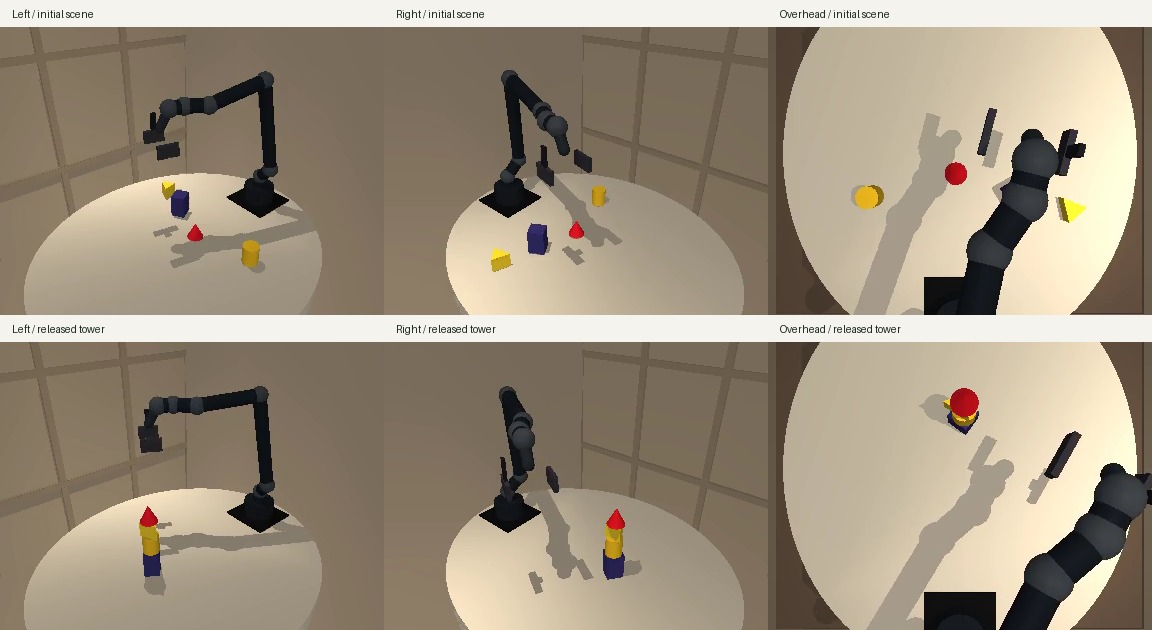
Make contact carry the work
The blocks have free joints. The jaw closes on each object, transfers it through contact, opens above the support and retreats. There are no object welds, adhesion constraints or hidden object-position writes during execution. Physical table and mount geometry participate in collision checking.
The controller includes continuous joint-reference starts and measured vertical-gap corrections before release. Earlier accepted training demonstrations keep their recorded controller revision. Heldout collection begins only after training-scene preflight; the physical controller and acceptance thresholds then stay frozen.
Measure the tower after release
Every selected demonstration passes a final 2.0 s robot-contact-free window at 100 Hz. The support component stays unchanged, position and height variation remain below 2 mm, and angular variation stays below 2°. Robot trace checks at 1 kHz include actual joint acceleration, correcting a limitation in the earlier writing-data pipeline.
One height cannot describe all stages. A held object may set the highest instantaneous point. Contact graphs identify a ground-connected peak. A sustained window measures free-standing stability, while the final 2.0 s window describes the released result. These fields are exported separately.
Keep the failures visible
The 200 selected episodes come from 556 completed candidates. Their selection fraction is a property of this screened collection, not a policy success rate. Local failure records remain separate from positive demonstrations and from physically eligible candidates that were not selected.
Dedicated low-friction, overhanging-release and eccentric-load controls exercise failed grasp, falling blocks and tower collapse. An initial low-pad-friction probe did not cause the expected failure because the contact mixed friction with the object; that result is retained separately instead of being counted as a successful failure test.
One observation clock
The data contains 699,853 rows, 600 videos and three 384 × 288 views. Images and actions are native 25 Hz, with no inserted frames. Dense robot traces are saved at 1 kHz, and object/contact traces at 100 Hz. Source timestamps and causal label age document the small offset between those sampling clocks.
Official Python and JavaScript LeRobot readers validate the exported package. Same-runtime seeded replay covers the 30 scene multisets, and representative native-action replays check the command representation. These checks establish loading and simulation reproducibility on this runtime, rather than training benefit.
Vary scenes without hiding the scope
The scenes contain three, four or five objects, including repeated shape classes, across five layout families and three size scales. Train/validation/test contain 140/30/30 episodes and separate full-scene shape multisets. Active tower subsets can overlap across splits when a second cone remains unused.
The planner searches upright stacking orders, not every possible orientation or tower design. Foam is represented by rigid shapes with compliant contact, and the robot appearance uses independently authored primitives. Public video cannot establish metric dimensions, mass, friction or official scoring thresholds; those values are assumptions in the per-scene records.
Inspect the release
Ten complete episodes are public, with 30 full videos, source mappings and LeRobot metadata. The 200-episode repository uses manual access review. Read the feature policy, physical boundary and rights record alongside the data. No AA footage or official robot model files are distributed, and no official benchmark score, hardware result or learned improvement is asserted.